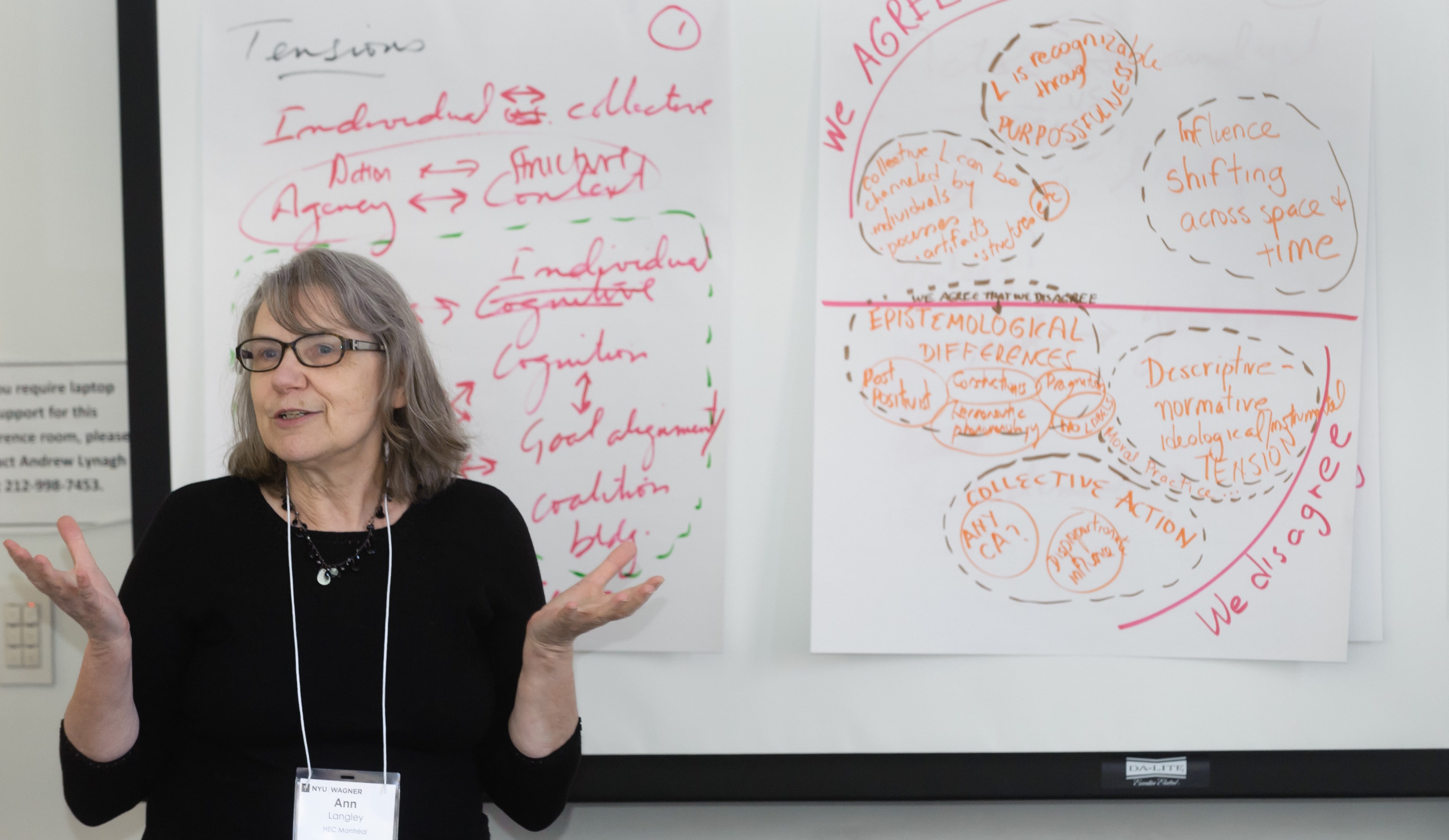
RCLA's original, cutting-edge research is shifting the discourse about leadership from a focus on heroic leaders to a more collective, relational and inclusive view.
RCLA scholars move beyond questions of who is a leader and what leaders do, to how leadership is practiced and how leadership makes change possible. We conduct research with leaders rather than on leaders to uncover and cultivate insights that describe leadership clearly and with an authentic voice.
RCLA's research radically expands the notion of how people at all levels of organizations and across all sectors of society can take up leadership for the public good.
As a research institute at NYU Wagner, one of the nation's top-ranked schools for public affairs, we believe that the best research is based on both uncompromising rigor and relevance to practice.
How Social Change Organizations Create Leadership Capital and Realize Abundance amidst Scarcity
By Sonia M. Ospina and Waad El Hadidy
Amid calls for less hierarchical leadership models, RCLA’s research offers a unique window into nonprofits that are effectively practicing more collective forms of leadership and how leadership happens as they produce social change in communities. The leadership of these social change organizations creates pockets of abundance where there is scarcity and shapes public spaces for deliberation, contestation and collective action that transform thinking, policy and systems. This short piece offers highlights from RCLA's eight-year research project with social change nonprofits recognized for excellence through the Ford Foundation's Leadership for a Changing World program.
Leadership, Diversity and Inclusion:
Insights from Scholarship
By Sonia M. Ospina, Waad El Hadidy and Grisel Caicedo with Amanda Jones
In a report released in partnership with National Urban Fellows, RCLA scholars examine recent research on leadership and diversity, with a focus on public service. They find that scholars are linking diversity with adaptability, arguing that learning how to build organizations that effectively leverage racial diversity can foster the leadership capacity to adapt to other kinds of diversity and thrive in an increasingly complex environment. Yet there is less agreement in the literature on just how to do that. Limited empirical research in the public service field has resulted in a dearth of evidence for what works, even two decades after the diversity agenda has become a focus for public service organizations.
"Popular Education"
By Waad El Hadidy, Sonia Ospina, and Amparo Hofmann-Pinilla. Political and Civic Leadership: A Reference Handbook, Edited by Richard A. Couto, PhD
Popular education, initially an approach to critical education and literacy, is gaining currency in the social change field as a useful approach to organizing. In the chapter “Popular Education” in the just-published book Political and Civic Leadership, RCLA scholars Waad El Hadidy, Sonia Ospina, and Amparo Hofmann-Pinilla discuss how Latino social change organizations use popular education to nurture learning and leadership for action within their communities. They also share implications for the field in terms of leadership as a collective achievement.
Baby Boomers, Public Service and Minority Communities: A Case Study of the Jewish Community in the United States
By David M. Elcott
This report finds that most Jewish Baby Boomers see retirement as a time for work and service, not rest. But organizations serving ethnic or religious communities may be unprepared to tap this potentially huge influx of talent. The report by NYU Wagner professor David Elcott, PhD, includes results from a nationwide survey of more than 6,500 Boomers about their future plans for civic engagement and offers organizations practical recommendations for engaging Baby Boomers in meaningful ways.
"Building Bridges from the Margins: The Work of Social Change Leadership," The Leadership Quarterly
By Sonia Ospina and Erica G. Foldy
In spite of fundamental differences in purpose or structure, social change organizations often collaborate with each other to achieve shared goals. In this article, RCLA faculty members Sonia Ospina and Erica Foldy draw on data from a national multi-year study to explore how the organizations' leadership fosters connectedness between independent organizations. The study describes five leadership practices that contribute to interdependence between organizations either by forging new connections, bolstering existing connections, or capitalizing on strong connections.