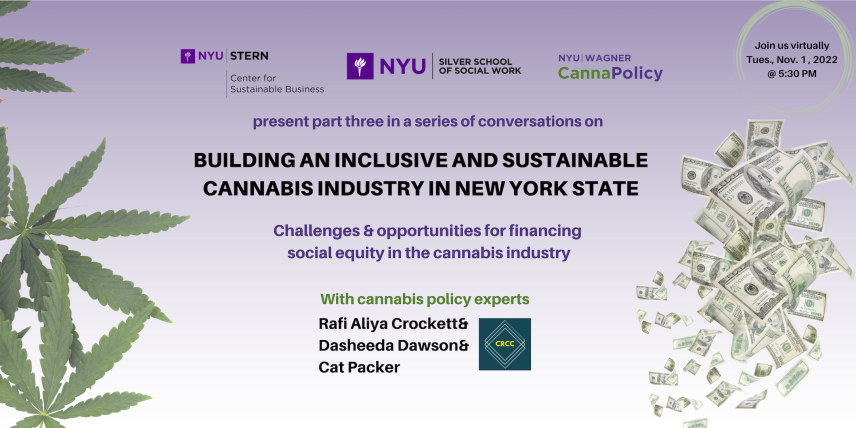
Building an Inclusive and Sustainable Cannabis Industry in New York State
The New York State Marijuana Regulation and Taxation Act, enacted in March 2021, legalizes the production, sale, and use of marijuana in New York State. Importantly, the law requires that 50% of all licenses be provided to “social equity applicants.” But this commitment to benefit communities most harmed by the War on Drugs is incomplete without also providing access to capital, technological expertise, and business support for licensees, and training and pathways to employment within the industry for justice impacted populations.
NYU CannaPolicy is partnering with NYU Stern Center for Sustainable Business (CSB) and NYU Silver to present a three-part series of conversations with the overarching theme “Building an Inclusive and Sustainable Cannabis Industry in New York State.”
On Tuesday, Nov. 1 at 5:30 p.m. EST. NYU CannaPolicy will host part 3 of this series: Challenges & Opportunities for Financing Social Equity in the Cannabis Industry. Joining us are cannabis policy experts Rafi Alayi Crockett, Dasheeda Dawson, and Cat Packer, co-authors of Not a SAFE Bet: Equitable Access to Cannabis Banking and executive board members with the Cannabis Regulators of Color Coalition (CRCC).
Our panelists will discuss the SAFE Banking Act, the MORE Act, and the SHIP Act – three pieces of legislation that will shape the future of finance in the cannabis industry – and more importantly, the financing of social equity entrepreneurs and investment in communities harmed by prohibition.
- Read more about our planned discussions for the SAFE Act, the MORE Act, and the SHIP Act below.
- Tune in for Part 2 of the Building an Inclusive and Sustainable Cannabis Industry series: Equitable Employment, Education, and Public Health on October 27, 2022 from 5-7 PM.
NYU CannaPolicy is a collective of graduate students and alumni out of the NYU Wagner School of Public Service working to provide our community with the tools, resources, and education necessary to responsibly advance cannabis legalization, rebuild communities harmed by prohibition, and positively impact the development of the nascent cannabis industry.
The Cannabis Regulators of Color Coalition (CRCC) is a coalition of government officials appointed or selected to lead, manage, and oversee regulatory and policy implementation for legal medical and adult-use cannabis markets across the nation and abroad. As leaders in post-prohibition cannabis policy, they focus on equity-centered regulation, industry best practices, and cannabis competency and standardization.
Safe and Fair Enforcement (SAFE) Banking Act
With the federal criminalization of cannabis still ongoing, small cannabis businesses and in particular social equity licensees, continue to face barriers to accessing capital through traditional avenues such as loans and banking services. The SAFE Banking Act has been lauded as a policy that will remove these barriers and create opportunities for small businesses to thrive in an industry dominated by large commercial operators. With an increasing number of states legalizing cannabis and launching social equity programs, such a policy is necessary if we are to see these programs and their participants succeed. Panelists will discuss the implications of the SAFE Banking Act, its potential shortfalls, as well as opportunities for change that would enable this legislation to positively support the realization of social equity in New York’s cannabis industry.
The Marijuana Opportunities Reinvestment and Expungement (MORE) Act
Under the MORE Act, a grant program, known as the ‘Community Reinvestment Grant Program’, will provide eligible entities with funds to administer community level services for individuals adversely impacted by the War on Drugs, including job training, reentry services, youth services, and health education Programs. Panelists will discuss the implications and societal benefits of such grant programs in New York, including how this approach to reinvestment can build new systems and solutions to address racial inequities for communities of color to narrow the wealth gap and break generational poverty.
The Small and Homestead Independent Producers (SHIP) Act
The SHIP Act would allow small businesses to sell directly to the consumer within and across state lines, once cannabis has been decriminalized at the federal level. This policy seeks to protect and support local farmers and craft cannabis growers within the cannabis industry, which has largely been controlled by major commercial operations and which will only grow more competitive with federal legalization. Panelists will discuss the potential impact of the SHIP Act on opportunities for employment and entrepreneurship, including the unprecedented opportunity it presents for transitioning historic legacy operators – who continue to be excluded from traditional licensing schemes – into the legal market.