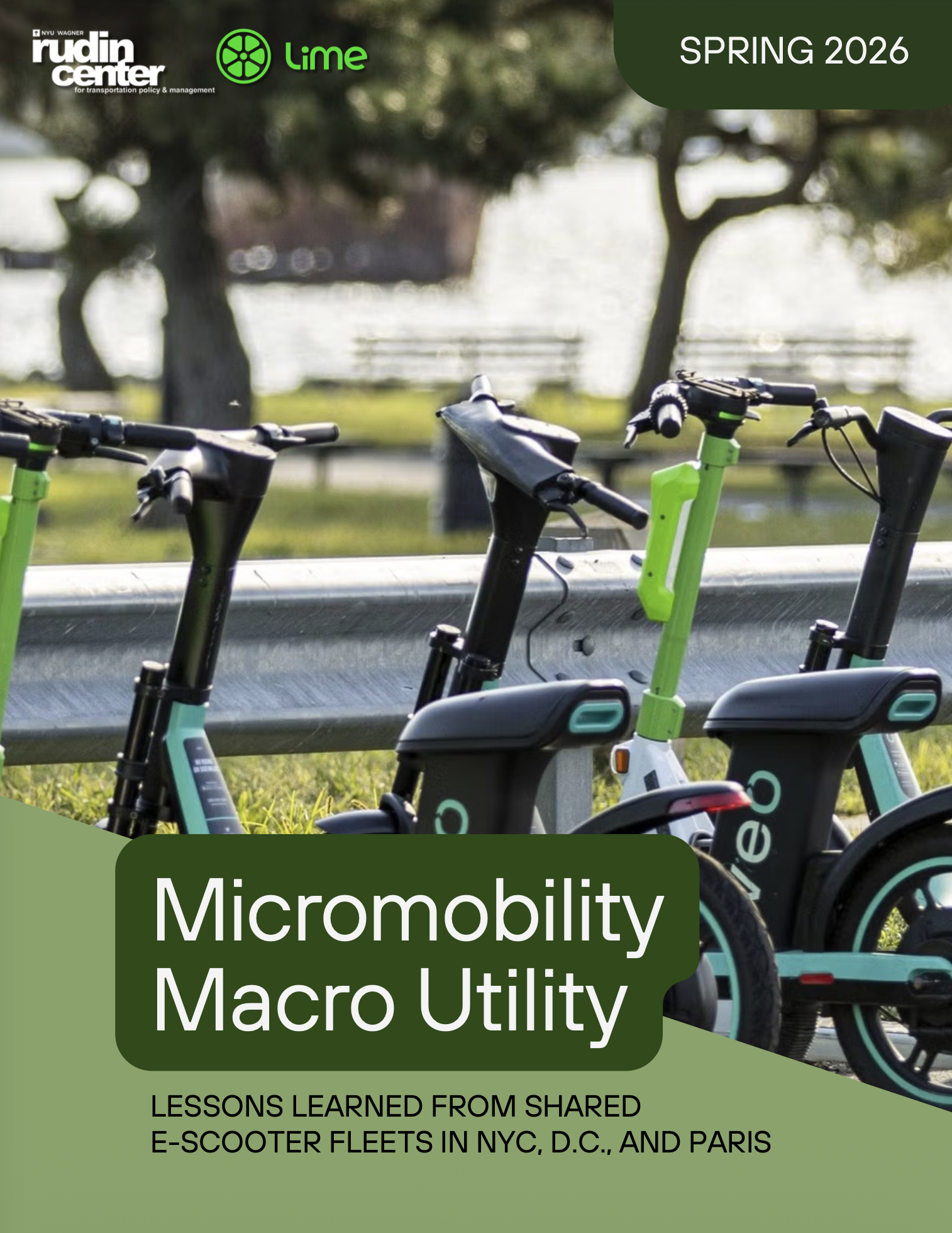
Micromobility, Macro Utility
Lessons Learned from shared E-Scooter Fleets in NYC, D.C. and Paris
We are pleased to release our full report exploring the impacts of shared e-scooter fleets in three global cities. Find the full PDF of the report at the bottom of this page, following the executive summary.
Shared e-scooters can strengthen urban transportation systems when paired with thoughtful policy, infrastructure, and oversight.
This report evaluates the urban impact of Lime’s shared e-scooter fleets in New York City, Washington, D.C., and Paris, drawing on municipal open data, Lime trip data and surveys, and relevant academic literature. We assess traffic flow, transit connectivity, safety outcomes, parking compliance, and equity impacts to inform future policy decisions.
Shared e-scooters do not measurably increase vehicle traffic, and may help to reduce car reliance.
An analysis of Average Annual Daily Traffic (AADT) in high-ridership corridors across the Bronx, Queens, D.C., and Paris shows no clear association between e-scooter deployment and increased vehicular traffic. Survey data indicates meaningful levels of vehicle substitution, with 16–23% of riders in the three cities reporting that they replaced a motor vehicle trip with a scooter ride.
While scooters alone do not transform traffic patterns, they function as part of a broader mobility ecosystem that can reduce reliance on private vehicles.
E-scooters play a significant first- and last-mile transit role.
Across the cities in this study, a substantial share of scooter trips begin or end near subway stations. In the Bronx, 41% of Lime trips occurred within a quarter-mile of subway stations. In Washington, D.C., the figure was even higher, with 58% of trip-starts and 72% of trip-ends occurring near Metrorail stations.
In neighborhoods with limited subway density, scooters can provide critical connective infrastructure. Survey responses in Paris further reinforce this pattern: over 65% of riders reported that scooters helped them access public transit.
Micromobility offers connective tissue that extends transit’s reach.
Safety outcomes are comparable to cycling, and incidents are more prominent in personally-owned, not shared, scooters.
Analysis of collision data suggests that shared e-scooter fleets are not disproportionately associated with severe injury or fatality rates when compared to cycling. In NYC, the vast majority of e-scooter collisions occurred outside shared fleet service areas, suggesting that privately owned scooters account for more incidents.
Internal data from Lime indicates incident rates well below 0.01% of trips across all cities studied. These rates are commensurate with bicycle injury rates in both NYC and D.C.
Perception of safety, however, remains a significant factor. Media narratives and public concern often exceed measured risk levels, highlighting the importance of infrastructure design, enforcement, and public engagement.
Parking compliance improves with infrastructure density and clear rules.
Both NYC and D.C. make use of Mandatory Parking Zones (MPZs), and D.C. additionally requires scooters to be locked to fixed objects. Research shows that parking compliance improves significantly when designated parking corral density reaches approximately 25 corrals per square kilometer, or about 40 per square mile.
Parking complaints persist in D.C., though rates relative to fleet size remain modest. The data suggests that parking management must be treated as both an infrastructure question and a behavioral one.
Equity impacts are mixed but promising.
We find little connection between neighborhood poverty rates and scooter trip volume. However, demand for reduced-fare programs in NYC is strong, indicating that financial access initiatives are essential for ensuring equitable use.
In neighborhoods with lower transit density and historically uneven access to opportunity, scooters can serve as meaningful connectors, but only if pricing and deployment strategies are intentionally designed to reach underserved communities.
Policy Implication
Shared e-scooters are a flexible, low-emissions mobility layer that performs best when embedded within comprehensive transportation planning.
Cities considering expansion should focus on:
- Coordinated transit integration
- Protected micromobility infrastructure
- High-density parking corral coverage
- Equity-focused pricing programs
- Transparent data collection and performance monitoring
When paired with infrastructure and policy alignment, shared e-scooters can expand access, complement transit, and support safer, multimodal urban streets.