

Student Spotlight: Dalia Rubinstein (MPA-PNP 2027)
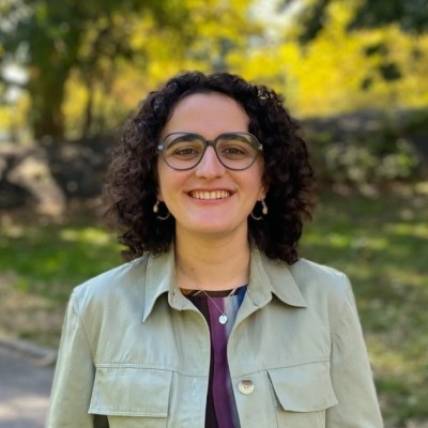
DALIA RUBINSTEIN (MPA-PNP 2027), CO-PRESIDENT OF KEHILLA
Dalia is a first-year MPA-PNP student specializing in Advocacy & Political Action. She serves as Co-President, Communications & Marketing Manager of Kehilla: A Jewish Hub at Wagner. Dalia partnered with her fellow co-presidents to launch Kehilla with the goal of creating a welcoming space for Jewish students to connect professionally, socially, and spiritually at Wagner. Embracing her identity as a Franco-American and Jewish student, cultural connection and exchange is especially important to Dalia. Before coming to Wagner, she represented Jewish students as an undergraduate at Wesleyan University, and worked to promote cultural exchange through her previous role at the French Embassy.
You specialize in Advocacy as a Wagner student. What inspired you to launch Kehilla?
I was Co-President of the campus Jewish community at Wesleyan University. I wasn’t necessarily expecting to follow the same path in graduate school, but when I attended Wagner’s Admitted Students’ Day and saw that the school didn’t have a Jewish students’ association, I knew that I would be part of creating one. At the start of the year, Beckie Hamroff of the Bronfman Center for Jewish Student Life put out a call for students interested in starting a Jewish student group at Wagner. I was connected to Dariela Farcas and Eva Vesmanova, and we started building from there! We also consulted existing graduate groups at Stern, Silver, and the Law School to learn about their experiences and best practices. While running this kind of organization is different at a graduate versus undergraduate setting, the core components remain the same: to build community, foster personal growth, and enrich campus life for students of all backgrounds. My choice of specialization was informed by my experiences in Jewish and interfaith advocacy, so the link has always been there for me. The desire to represent and be represented is my most direct connection between starting an identity group and deciding to specialize in Advocacy. This year, Kehilla tabled at Admitted Students’ Day and met with prospective students interested in joining the club, which was a real full-circle moment for me.
As Kehilla gains momentum, what programs or initiatives are you most excited about?
First, I want to say how thrilled I am with Kehilla’s inaugural semester! Our work so far has focused on building Jewish community and fostering dialogue around the intersection of Judaism and public affairs. I’m grateful to all those who joined to celebrate our club launch, Purim, and Passover as a community, which showed us that the effort of founding a new student organization was worth it. We also hosted an event for Yom HaShoah in partnership with 3GNY, focused on Holocaust remembrance for public service leaders. The event explored the importance of upholding this legacy in a world with increasingly few Holocaust survivors, at a time when knowledge of the Holocaust is particularly low amongst young people. As the group continues to grow, I hope that we’ll be able to continue hosting robust events that foster learning and dialogue. So far, we’ve leaned on our personal networks to bring in outside voices. As our group's foundation solidifies, we’ll be thinking more about the kinds of partnerships we can develop to deliver exciting and innovative programming. I can’t wait to see where things go in our second year!
Your background spans law, media, diplomacy, and cultural communications. What first drew you to work centered on storytelling and public engagement?
I’ve always felt drawn to community building - from Girl Scouts and Student Council growing up, to the Jewish community at Wesleyan University, and now in New York City. Building and nurturing relationships is what is most rewarding to me. Most recently, I worked at the Embassy of France in the United States, supporting initiatives that fostered cooperation between the two countries across culture, education, and language. It was a new experience to actively work on developing the Franco-American relationship, which I’ve been immersed in my whole life, from the standpoint of my academic background in politics and international relations. I served on the Communications Team, telling the stories of our initiatives and this relationship through photo, video, short- and long-form interviews, and more. Holding both countries very close to my heart, I also sought to disrupt oversimplified, stereotyped perceptions the two countries might have of one another, in the hopes of developing a more genuine and authentic relationship. Being personally attuned to these oversimplifications made me think more deeply about the kind of content I was putting out and about my role in shaping the narrative, and pushed me to be more intentional in my work.
You spent more than two years working with the Embassy of France and Villa Albertine. What did that experience teach you about cultural diplomacy and international exchange?
Within the Embassy, I worked for Villa Albertine, the French Institute for Culture and Education. Because we specialized in these two sectors, I discovered a wide variety of ways to tailor cultural diplomacy initiatives to very specific settings. For instance, the codes and norms of academia differ significantly from those of the film world, so we had to adapt. We devoted a lot of attention to developing and communicating our initiatives in ways that would resonate. This experience showed me the plethora of avenues to continuously refine perspectives and deepen relationships. Thinking about today’s numerous global crises, I certainly don’t think that these can be solved with cultural diplomacy alone. That said, this experience did show me the importance of having common forums and investing in maintaining relationships that can sometimes be fraught. Relationships are what obligate us, and I don’t believe that nations can be accountable to one another without having one.
Across those roles, you’ve worked with very different audiences and institutions. How has that shaped the way you communicate and build connections?
My dad is French and my mom is American, so it’s been instinctive for me from a young age to foster intercultural understanding and exchange. My earliest memories of this are facilitating communication between members from different sides of my family who did not speak the same language. Now in the work I do with Kehilla, my Co-Presidents and I all grew up in countries with smaller Jewish communities - in Russia, Chile, and France - and it’s been really rewarding to place our backgrounds in conversation with the larger Jewish hubs that exist in the United States and Israel and to give ourselves a seat at that table. Dariela, Eva, and I wanted our group to reflect and honor the diversity of the global Jewish diaspora, and we were very intentional about including that language in our founding charter. Having our group encompass this diversity isn’t only the right thing to do, it also helps us design more interesting and expansive programming and connect to a larger audience. So I really see it as integral to the success of our work.