

Student Spotlight: Difa Farzani (MPA-PNP 2027)
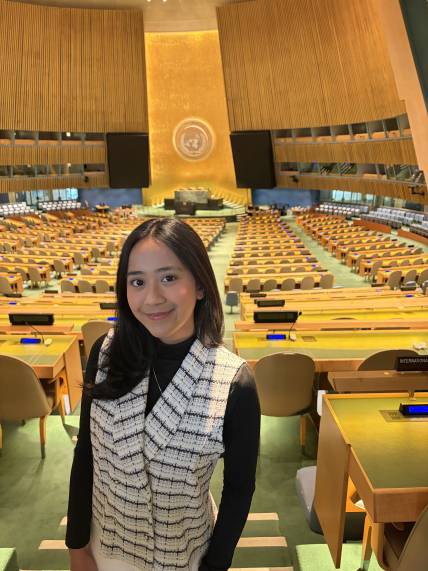
Difa Farzani (MPA-PNP 2027), co-chair, Wagner Public Interest Technology
Drawing on her background on digital public infrastructure in Indonesia, Difa Farzani (MPA-PNP 2027) is now exploring the emerging field of Public Interest Technology as co-chair of W-PIT and as an intern at NYU Alliance for Public Interest Technology. Her work as a student specializing in Social Impact, Innovation, and Investment has also included an award-winning
You’re serving as co-chair of Wagner Public Interest Technology. What inspired you to get involved with W-PIT, and what initiatives are you excited about this year?
The whole idea of W-PIT, to create a new community at Wagner around something that is becoming increasingly relevant to public service, resonates very strongly with me. Technology is already changing how we deliver services, make decisions, and engage with communities, and I think it’s important for public service students to be part of that conversation proactively and think critically about how technology should be used.
I’m excited to showcase PIT projects from across NYU schools and our upcoming community meet-up in November. We’re hoping to bring students together from across NYU who are already working on PIT-related projects, as well as those who are curious about the field and explore what public interest technology can look like across different disciplines.
Public Interest Technology is a growing field. What has drawn you to this kind of work and what impact do you hope to make?
In Indonesia, I worked on digital public infrastructure, tech-enabled Government-to-Person social assistance delivery, and digital upskilling programs that helped the working population re-enter the workforce after COVID-19 pandemic. Those experiences showed me how much technology can expand access to public services and create new opportunities.
At the same time, they also made me more interested in the questions behind the technology: Who gets to design these systems? Who benefits from them? Who might be left out? And how do we make sure they are used responsibly?
I hope to contribute to a more thoughtful conversation about technology in the public sector. I don’t think the answer is to see technology as inherently good or bad. We have an opportunity to make sure that when we use technology to solve public problems, we do it intentionally, ethically, responsibly, and with the people we are trying to serve at the center.
You’re also a strategic initiatives intern for the NYU Alliance for Public Interest Technology. What kind of work do you do and how is the experience shaping your future goals?
I’ve been working on community activation by preparing the PIT project showcases, connecting with different NYU schools, gathering student insights, and helping plan new opportunities for the PIT community.
My current role at the Alliance helped me to see how interdisciplinary PIT really is. My previous work focused largely on digital transformation from a government and policy perspective. Now I’ve been exposed to people working across design, technology, policy, research, education, and community engagement.
As an SI3 student, I’m interested in how innovation and technology can address social challenges. My experience at the Alliance has shown me that meaningful public impact requires bringing different perspectives together. It has broadened how I think about my future work in creating a responsible, tech-enabled innovation for public good.
In the spring, you were a part of the winning nonprofit team in the inaugural Social Impact Venture Challenge. Tell us about Nexus and what it meant to you to win.
The idea grew out of something I’ve cared about for a long time: creating pathways for young people to dream bigger and build the confidence to believe that those dreams are possible.
Nexus is a near-peer mentorship and microgrant initiative designed to help rural Armenian students access university pathways. We connect students with mentors who have recently navigated similar journeys and provide microgrants to help make their goals more attainable.
Winning the Social Impact Venture Challenge meant a lot to me because it validated an idea that is deeply personal to me. I’m also grateful that coming to NYU brought me together with like-minded, mission-driven people, especially my teammates Jill, Hayk, and Jata. Nexus is a reminder of what can happen when people with different experiences but a shared mission come together and decide to build something collectively.
What advice would you give to a first-year Wagner student just starting their journey?
For me, grad school is both a choice and a privilege. If you made the conscious decision to be here, give it your whole heart and make the most of it. Keep coming back to the reason you chose this path in the first place. When you stay connected to that, your “grad school world” starts to build itself around it.
There’s also so much to explore beyond the classroom at Wagner and across NYU. Join a community that resonates with you, build genuine relationships with faculty you’re excited to learn from, and think about what you can contribute as much as what you can gain.
And don’t forget to have fun! New York City is an exciting place to be, and grad school doesn’t always have to be only about building your resume. Be intentional about everything you build; you’ll be surprised by how much you can get when you show up that way.