

Student Spotlight: Eva Vesmanova (MUP 2026)
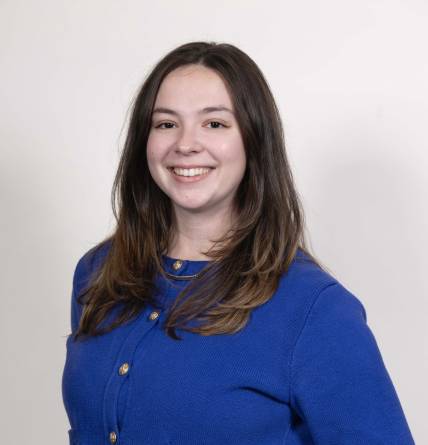
EVA VESMANOVA (MUP 2026), CO-PRESIDENT OF KEHILLA
Eva is a second-year MUP student focused on how zoning, public policy, and real estate development shape neighborhoods. Currently, Eva serves as a Graduate Planning Consultant at the New York City Department of City Planning. Before coming to Wagner, Eva earned her Bachelor's in Urban Studies at the University of Washington, where she tackled urban planning challenges in Seattle.
Eva also serves as Co-President, Budget & Finance Manager of Kehilla: A Jewish Hub at Wagner. She partnered with her fellow co-presidents to launch Kehilla with the goal of creating a welcoming space for Jewish students to connect professionally, socially, and spiritually at Wagner.
Your background is rooted in planning, GIS, and neighborhood analysis. What first drew you to that work?
I was raised in Moscow, a large, dense city where I was always surrounded by urban life, architecture, and constant movement. That environment naturally sparked my interest in cities. When I moved to Seattle during high school, I realized how much I missed that energy, which really made me aware of just how different urban environments shape daily life.
That experience led me to study city planning in undergrad and pursue a GIS certificate, where I began developing technical skills and later worked as a GIS analyst. In graduate school, I started to see GIS not just as a practical technical tool, but as a way to really understand and analyze neighborhoods more deeply, which I’ve also done with the NYC Department of City Planning. That’s when it really clicked for me: planning is not just about physical space, but about people, communities, and making informed decisions. GIS is a powerful tool to support that work.
You’ve worked in both Seattle and New York in planning and geospatial roles. How have those different city contexts shaped the way you think about urban issues?
It showed me that while cities can look very different in scale and density, many of the underlying challenges are actually quite similar. In both places, issues like housing affordability, debates around density, and concerns about neighborhood change are central to planning conversations.
What’s different is how those challenges play out, given that New York operates at a much larger, more complex scale, while in Seattle, growth and change often feel more recent and contested. Experiencing both helped me understand that planning isn’t just about the physical form of a city, but about how communities respond to change. It reinforced for me that, regardless of the city, people want similar things. They want to live in places they love, have access to housing they can afford, and feel secure in their neighborhoods. That’s why listening to communities and grounding planning decisions in those needs is so important.
What made you want to get involved with Kehilla?
When I started at Wagner, I felt like something was missing—there wasn’t really a space where I could fully show up as myself. That made me realize how much community matters. Not just socially, but in feeling like you truly belong. Co-founding Kehilla was about creating that space for others: a place where students who share public policy interests and a connection to Jewish identity, or who simply want to show up in support of that community, can come together, feel safe, be themselves, and build something meaningful, especially during a time when that sense of community feels particularly important.
As Kehilla grows, what kind of community are you hoping it creates for students?
I hope it continues to build a community that feels safe, meaningful, and welcoming to everyone. A space where students can come together to learn about and celebrate Jewish holidays and traditions, while also connecting through shared public policy interests. More than anything, I want it to be a place where people—whether they identify with a Jewish background or are simply curious and want to learn—can feel a sense of belonging, build relationships, and engage with each other in a thoughtful and supportive way.
In your current role at the Department of City Planning, you analyze housing, commercial activity, and neighborhood change. What has been most interesting or surprising about that work so far?
Realizing that there isn’t always a standardized set of metrics for evaluating neighborhoods after a rezoning. I initially assumed that once a rezoning happens, there would be a clear, consistent framework to track its impacts over time. However, that’s not always the case. Being part of a project that helps think through how to measure those changes has been really interesting. I’ve also found the project management side of the work especially valuable. Leading a team, keeping everyone aligned, and learning how to move a project forward while working closely with the Department of City Planning has been a great experience. It’s taught me how to balance technical analysis with collaboration and communication, which I’ve come to see as just as important.
As you get ready to graduate, what kind of planning work are you most excited to keep pursuing?
I’m most excited to continue working on projects in New York City, ideally at the intersection of development and public planning—whether that’s with a developer or a city agency. I’m especially interested in adaptive reuse and housing, and in thinking about how existing spaces can be transformed to better serve communities. More than anything, I want to be involved in projects that are grounded in the needs of New Yorkers, by listening to communities and helping shape development that is not only functional, but meaningful and responsive to the city.