

Alumni Spotlight: Sophia Romee (MPA-PNP 2017)
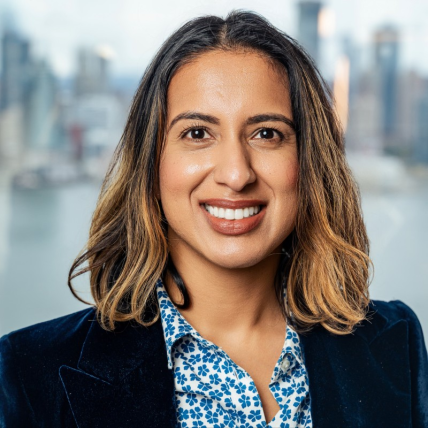
Sophia Romee (MPA-PNP 2017), founder of DiscernIt
How do you prepare 7 million students and a 125-year-old organization for the rise of generative AI? Ask Sophia Romee. As the general manager of the College Board’s GenAI Studio, she led the charge in developing responsible, human-centered AI assessments for critical skills. But she began building at the intersection of education and impact long before that. Sophia is a proud NYU graduate who began her career at NYU Stern, advising the dean of the undergraduate college. After graduating with an MPA in Public & Nonprofit Management and Policy from NYU Wagner, Sophia led research and analytics at the Network for Teaching Entrepreneurship for the future of work, and she co-founded Radical Reset, a social enterprise focused on intentional rest and reflection for leaders. She returned to NYU Wagner as an adjunct professor to teach data visualization and storytelling. Now, she's tackling a new frontier as full-time founder of DiscernIt: measuring whether people know when—and when not—to trust AI. Read on as she shares her journey from NYU Wagner to the cutting edge of public interest technology, why 6-month roadmaps are the new normal, and her top advice for current students.
You founded the GenAI Studio at College Board at a moment when schools were just beginning to grapple with generative AI. What were you looking to build, and how did that work evolve?
In 2023, as ChatGPT entered public consciousness, I became curious: what could generative AI mean for learning? I kicked off the strategy project at the College Board with one guiding principle, to lead with people and their needs rather than the technology. This grew into the GenAI Studio, a startup inside a 125-year-old organization, scaling from zero to 25 people across product, engineering, and data science in less than two years.
We worked in two directions. Inward, we brought AI to College Board's 2,000 staff, becoming expert enough in the technology to advise other teams on integrating it responsibly while building our own tools, like a goal-writing assistant that simplified performance evaluation by helping people connect their work to their strategic priorities. It was important to me that we focused on employee delight and not just efficiency. Outward, we developed new AI-enabled experiences that allowed students to show mastery of hard-to-measure skills like collaboration and oral communication in more authentic ways. Both directions were hard in different ways, and both kept pushing us to evolve because the technology changed every few months, there was little policy to point to, and getting it right depended on who we had in the room. I never made a roadmap longer than six months, which seems to be the new normal.
Can you tell us a little about your career path and how you became interested in the intersection of education, technology, and public service?
A lot of it traces back to my childhood. I moved from India to Miami when I was nine and grew up in Little Havana, where my mom went from teaching at a community college in India to teaching middle school in low-income parts of Miami. I experienced firsthand how much a zip code can dictate your outcomes, but I also experienced the power of community and civic engagement. A pivotal social entrepreneurship class I took as an NYU undergrad (I am an NYU lifer!) introduced me to tikkun olam, the Jewish concept of repairing the world, which has been my moral compass for the jobs I've taken ever since. This is why I care about democratizing learning, whether it be through my time as chief of staff to the dean at NYU Stern; leading education research at the Network for Teaching Entrepreneurship (NFTE); or my work at College Board, where before AI I founded a two-year strategy fellowship for people who never would have called themselves strategists and led incubation for AP Career Kickstart, a new set of courses to prepare high school students for in-demand careers. Technology is often the medium, but building pathways and products to help people gain the skills they need to live meaningful, economically sustainable lives has been my throughline.
College admissions and assessment are changing quickly as students gain access to increasingly powerful AI tools. How do you think institutions should rethink what they measure and what counts as authentic student work?
Students are often better at using AI than the adults around them, so I'm less worried about whether they can use it and more interested in whether they know when not to. At College Board, we convened AP (Advanced Placement) educators to draft the first AI guidance for a few AP courses back in 2024 when it became clear that a one-shot AI prompt could produce a decent research paper within AP Seminar. Seeing educators debate what constituted authentic student work was fascinating, and we landed on breaking apart the writing process into steps. Using AI to explore a topic was fine, because it might show you a way of looking at the world you hadn't considered, but writing the draft was not, because learning to write in your own voice is the point. The question stopped being whether AI can do it and became whether it should. I think assessment will become far more process-based, multimodal, and less text-heavy, closer to real-world settings. That also lets students show what they couldn't before, whether they're strong thinkers who struggle with polished writing or students whose first language isn't English, and it opens the door to capturing durable skills like collaboration that have never been measured well at scale.
You recently transitioned from the College Board to become a full-time founder. What's your mission, and what inspired you to take that leap?
DiscernIt exists because I held two jobs at once at College Board, building AI-enabled assessments of hard-to-observe skills while also being accountable for how 2,000 colleagues adopted AI. I started the company because I was increasingly convinced that blind acceptance of AI is bad for kids and bad for adults, and I wanted to build something that would change how we learn and work for the better. DiscernIt measures AI judgment, whether someone knows when to lean on AI, when to check it, and when not to reach for it at all, so organizations can see what effective AI use looks like across their teams and scale the behaviors of their most discerning people. I am in the early days of the startup. While the transition from intrapreneur to entrepreneur has been a whole new learning curve—for the first time in my life I have to care about a product's commercial viability—I feel grateful and excited to be a shaper during this disorienting, momentous inflection point for society.
Looking back, how did your time at Wagner shape the way you approach education and technology? What skills or experiences do you still draw on today?
I was a chief of staff at NYU Stern when I chose between an MBA at Stern and an MPA at Wagner, and most of my mentors told me to get the business degree. I listened to my gut because I wanted to be in a community of public service, and I don't regret it at all. Wagner is where I fell in love with statistics as an anthropology undergrad who hadn't taken a single STEM class all throughout college. Professors like Rajeev Dehejia pushed me in the best way and made me love quantitative rigor, which shaped my next job as an education researcher and still drives how much methods and measurement matter to me at DiscernIt. Once I was working, I saw how much it mattered not just to analyze data but to move people toward data-driven decisions, so I came back as an adjunct to teach data visualization and storytelling, eventually becoming course lead and bringing better tools and technology into our offering. I continue to lean on Wagner's community, having made lifelong friends and collaborators. My first venture, Radical Reset, was co-founded with Wagner alum Tes Cohen!
As someone who has built new initiatives inside large institutions, taught graduate students, and now launched a startup, what advice would you give Wagner students looking to build careers in public interest technology and responsible AI?
- Stay curious and embrace the beginner's mindset. For me, learning has always trumped everything. Whenever I've felt too settled, I've taken it as a sign to look outside my comfort zone, which is often how most new things that I have done came into being.
- On AI specifically, I would urge everyone to learn out loud and across disciplines. One of my proudest moments at the GenAI Studio was bringing together product and technology specialists with learning science and measurement experts. We collaborated in practical ways through prompt mobbing, where product people, engineers, data scientists, and subject matter experts would get in a room, run a prompt, and debate and iterate live. In my experience, some of the most innovative, inclusive AI advancements happen when people with different backgrounds learn from each other and build together.
- Be a shaper rather than a spectator. We will all need to be builders in this changing world and becoming fluent with the latest technology is a must-have, no matter if you are the one building tools or shaping policy on how best to use them.