

Learning in Community: Exploring Leadership and Social Change in Puerto Rico
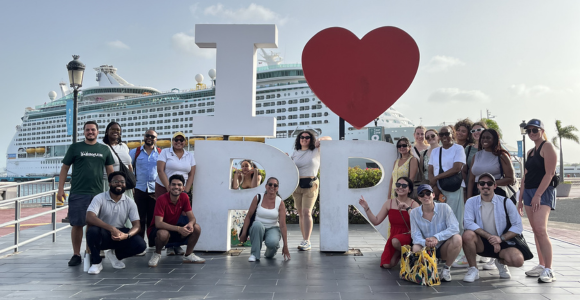
This summer, a cohort of 17 students from NYU Wagner and across the University joined Professor Judy Pryor-Ramirez for Leveraging Leadership for Organizational Success, a travel course that included a weeklong immersive trip to Puerto Rico.
“The opportunity to study leadership not in a classroom, but in Puerto Rico—on the ground, in community, in relationship—felt like exactly the kind of learning I needed at this stage of my career and my graduate studies,” said Kimberely Jackson-Brown (MPA 2027), a nonprofit professional with over 30 years in the field.
Pryor-Ramirez noted that the course was two years in the making and a special passion project for her. “This course brings together deeply cherished parts of my teaching and my research practice,” she said, “so it’s been a joy to pull together a place-based learning experience, especially in a place that is so profoundly meaningful to my family and me.”
The course explores the legal and political mechanisms that impact social sector leadership in Puerto Rico, given its territorial status. Students investigate the 3Ps—promises, problems, and paradoxes—to analyze how leaders problem-solve and innovate when navigating multiple crises.
“I was drawn to the opportunity to learn about Puerto Rico specifically, its political history and the ways its communities navigate colonial legacies, economic precarity, and self-determination,” said Dayana Qusipe Salome (MSW 2027). “Given my own background navigating systemic gaps as an immigrant, I was eager to understand how another community organizes, resists, and sustains itself under similar structural pressures.”
Prior to departing for Puerto Rico, students attended class sessions to establish their theoretical foundation, studying the history and politics of Puerto Rico, leadership frameworks, community engagement ethics, and collaborative ethnography.
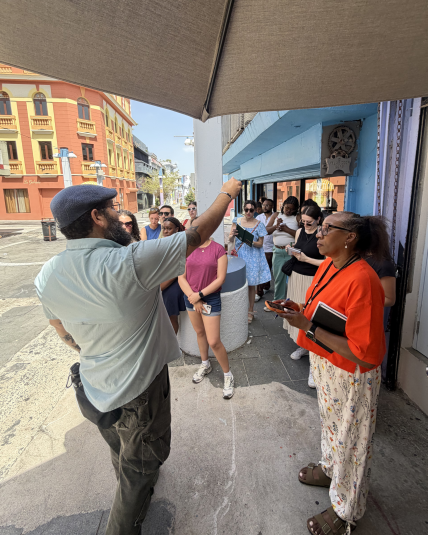
“My grandmother was born and raised in Santurce before moving to New York in the late 1940s during the Great Migration, and so being Puerto Rican has always been part of how I understand my identity and navigate the world,” said Manuel Blasco. “I wanted to learn more about the political and economic forces that shaped her and my family's life and continue to shape daily life on the island.”
The seven-day trip featured talks and visits with guest leaders from community partners around Puerto Rico, including:
- José Caraballo Cueto, PhD, Professor, Graduate School of Business, University of Puerto Rico
- David Soto, Founder and Executive Director, Ruta Borinquen
- Federico Cintron Mocosco, PhD, Director, El Puente Puerto Rico
- Tania Rosario Méndez, MPH, Executive Director, Taller Salud
- María Iniro and Carola Oliveras-Rodríguez, Staff from Proyecto ENLACE del Caño Martín Peña; and G8 Community Leaders Evelyn and Natalia
- Xiomara Caro Díaz, Executive Director, The María Fund
- Colibrí Sanfiorenzo Barnhard, Executive Director, HASER
“To stand in the presence of Puerto Rican leaders who move through their work with such power, humility, compassion, and love was something I could not have anticipated and cannot fully put into words,” said Jackson-Brown.
Following each guest’s presentation, the class would meet in the afternoon for a topical lecture from Pryor-Ramirez, focusing on youth, feminist, community, and philanthropic leadership.
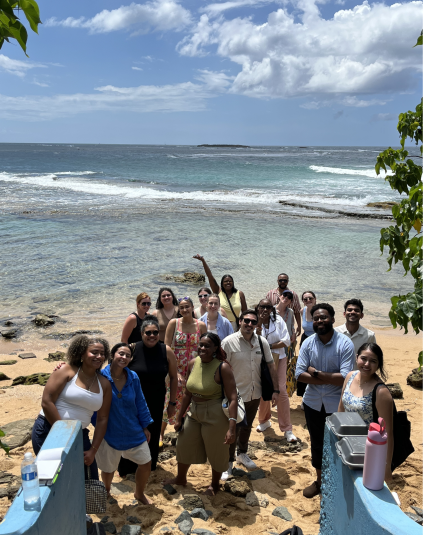
“As I compared organizations with different missions and leadership styles, I saw that they were confronting many of the same political, environmental, and institutional forces while sharing a commitment to protecting Puerto Rico’s people and keeping power within their communities,” said Blasco. “Seeing these principles of liberatory leadership in practice gave me a deeper understanding of how community power can serve as a check on institutional power.”
The discussions with community leaders were paired with site visits and sightseeing around the archipelago, including neighborhood walks around Río Pedras and Puerta de Tierra; a reflection session on the beach in Piñones; an estuary boat tour in San Juan Bay; and a building tour of Edificio Rizomas, a collaboration hub in Hato Rey.
After the trip, students returned to New York to “connect the dots” with a panel discussion at the Center for Brooklyn History and a guest lecture from Dani Castillo from El Puente Brooklyn. The course concluded with a learning colloquium, at which students each delivered an 8-minute presentation capturing the “goodness” and complexity of leadership in Puerto Rico by focusing on two sites they visited.
Many students named their presentations on direct quotes from community leaders. Blasco’s presentation was “Don’t Forget the People,” a quote from a leader at Proyecto ENLACE del Caño Martín Peña, and similarly, Jackson-Brown’s was titled “Don’t Forget the Goodness—A Portrait of Relationships and Accountability in Puerto Rico.”
“The title came from something I carried with me throughout the entire trip,” said Jackson-Brown, “this sense that goodness was present everywhere we went, in the organizations, in the leaders, in the communities, and that my responsibility as a learner and as a leader was to not let that goodness fade once I returned home.”
Jackson-Brown, Blasco, and Quispe Salome all agreed that the course has fundamentally shifted how they view leadership and how they plan to approach their own careers moving forward.
Quispe Salome concluded: “Rather than positioning leadership as directing change, I hope to practice leadership by fostering trust, promoting genuine participation, and advocating for systems that empower communities to shape their own futures.”