

Student Spotlight: Chanaporn (New) Tohsuwanwanich (MUP 2027)
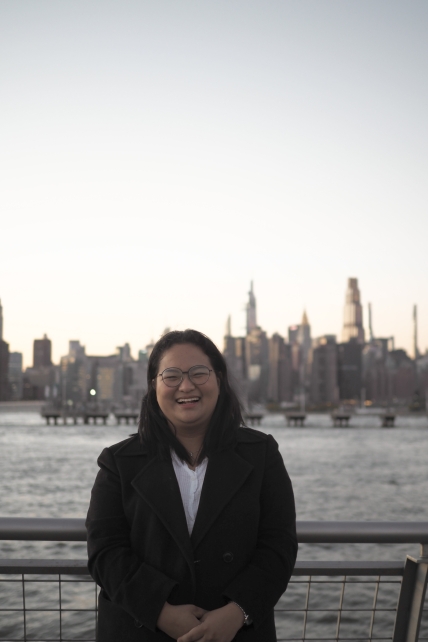
Chanaporn (New) Tohsuwanwanich (MUP 2027), co-chair, International Policy and Planning Association (IPPA)
Driven by a fascination with how people interact with the built environment, Chanaporn (New) Tohsuwanwanich (MUP 2027) brings a global perspective rooted in an undergraduate geography degree from UCLA. Her work bridges quantitative housing research at the NYU Furman Center with on-the-ground fieldwork—ranging from community-led slum redevelopment in Bangkok to leading student conversations on technology and international development through the International Policy and Planning Association (IPPA).
What led you from studying geography at UCLA to pursuing urban planning at NYU Wagner?
Wandering around the city has been one of my favorite things to do in my free time. I love exploring new places, learning about new cultures, and feeling the gentle breezes when I walk through buildings, parks, and the river. Geography, which encompasses built environments and nature, perfectly blends human interaction with the natural world. After four years in an undergraduate geography program, I want to deepen my understanding of how policies, finances, and housing shape people’s lives. While geography provides me with tools and a critical lens, I believe urban planning will allow me to put them into action and create impact in communities, cities, and the world. The International Development Planning specialization interests me because it draws on global lessons for community planning and applies them to multilateral organizations. This unique offering at NYU Wagner broadens my perspective on implementation from the local to the global level and helps me engage in timely conversations across all levels of implementation.
You studied the Baan Mankong housing program in Bangkok. What did that research teach you about the role residents can play in shaping decisions about their neighborhoods?
The Baan Mankong program is a slum redevelopment project in Thailand that, through collaboration with a quasi-government entity, CODI, and residents of informal settlements, forms a community savings group. Through this process, the program builds community capacity and financial literacy, allowing residents to decide on in-situ upgrading and allocate resources for community infrastructure. However, through Baan Mankong’s fieldwork, I learned that on-the-ground realities can differ significantly from the literature and conceptual understandings we have about a policy. It is important to understand these underlying dynamics and the continuum of the policy's impacts. Because not all dwellers have the same conditions and characteristics, participants have perceived the impacts of the Baan Mankong program differently, leading to a spectrum of opinions about community members' experiences. Baan Mankong reflects successful community organizing efforts, but the policy design should also account for residents' living realities.
As a research assistant at the NYU Furman Center, what question about housing affordability in New York City are you most interested in exploring?
Through my work at the NYU Furman Center, I have explored many aspects of housing, from landlords to the impact on tenants, the consequences of rezoning, and more. However, amid those policy conversations, there are not enough discussions about how we could create an innovative financing model that meets deeply affordable needs while remaining resilient to environmental and community demands, not only in New York City, but also in many cities in developing countries that face the pressing challenges of rapid urbanization. NYU Furman Center gave me the tools and data to understand communities and housing complexity quantitatively. In the future, I want to blend quantitative and qualitative approaches to address the housing affordability crisis, while staying responsive to community and future needs through creative finance, management, and development.
You helped organize the International Policy and Planning Association’s summit on climate, migration, and global resilience. Which IPPA initiative are you most excited to bring to the Wagner community this academic year?
This year, the International Policy and Planning Association (IPPA) invites you to explore the intersection of technology and international development more deeply! With the rise of Artificial Intelligence and advancing technology, there is not enough space to discuss how these technologies could advance international development across developed and developing countries. While it offers opportunities, it can also exacerbate development disparities through extractive resources, model biases, and the politics surrounding its use. Our conference will take place in late March 2027, and it has been one of the largest Wagner student-led conferences of the year! This year, we are presenting a half-day conference featuring a panel discussion and two workshops that let you dig deeper into the topics and explore practical implementation with our knowledge partners. We will keep you posted on more details—follow us on Instagram @ippa.nyuwagner and sign up for our newsletter for the latest updates!
In addition to the conference, please keep an eye out for our event series leading up to it, as well as the social and academic activities that will take place throughout the semester. Get connected, learn more about international development, and enjoy the company. We are excited to see you at our future events!
When you walk through a neighborhood for the first time, what’s one detail you pay attention to because of your planning background?
Every time I walk into a neighborhood, it awakens all my senses, from the eyes on architecture and buildings to the smells of streets, from the feelings I perceive to the tastes of the local street food. It is very challenging to name one specific detail, because I believe that all of these elements combine to make a place and a neighborhood special! My planning background leads me to question, on a deeper level, how people interact with their spaces, from the building uses to their activities. I also pay attention to how buildings are designed and how zoning might shape the built environment I see. I have always been keen to learn more about the ways of living for residents in the neighborhood, their culture and their expressions, which reflect on their built environment and their sense of community. As an urban planner and a geographer, I encourage you to walk outside, explore new places, and question your surroundings. There is no better way to learn about the community than by walking, and you might learn something valuable along the way!