

Alumni Spotlight: Eleni Manis (MPA-PNP 2020)
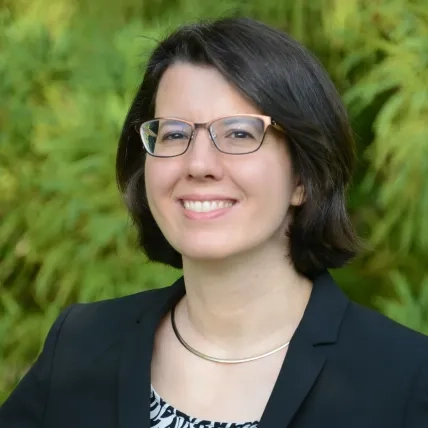
Eleni Manis (MPA-PNP 2020), Research Director, Surveillance Technology Oversight Project
Eleni Manis began her career teaching philosophy: a discipline that has been thrust to the forefront of the conversation around GenAI. Today, the NYU Wagner alumna serves as Research Director at the Surveillance Technology Oversight Project (S.T.O.P.), where she investigates how police use tools such as facial recognition and license plate cameras. Eleni shares what led her from academia to advocacy, why she believes communities should have a stronger say in public safety technology decisions, and how her time at Wagner shaped the course of her career.
1. What brought you to the Surveillance Technology Oversight Project, and what does your work there look like today?
While I was at Wagner, I was an intern and a fellow focused on tech policy in the NYC Mayor’s Office. I honestly planned to spend my career pushing for change from within the system. That didn’t happen, but in 2020 I was fortunate to join S.T.O.P. as its research director. I discovered I’m more of an advocate anyhow: I want to work on behalf of a coalition of affected community members who set the agenda they need.
Day to day, I research and write papers on how local and state police misuse surveillance technology. For example, in September 2026, I exposed the NYPD’s use of Flock, the notorious car-tracking company, with Andrew Case of LatinoJustice PRLDEF, covered in this New York Times article. I regularly talk with partners at aligned organizations about their concerns, and I stay in touch with lawyers and advocates who provide direct services to the communities at the center of S.T.O.P.’s work.
2. Your work examines technologies like facial recognition, drones, and government databases. How can advocates in public interest technology help governments use tools like facial recognition, drones, and large databases more responsibly?
There are spaces—like policing—where the only responsible action is to ban dangerous technology outright. S.T.O.P. works to ban police use of facial recognition, drone patrols, gang databases, and other irredeemable tools. We don’t want aspiring public-interest technologists to hand police more powerful tools. Instead, we want policy solutions that remove dangerous tech from city streets and that hold police publicly accountable for the tools they use. So, I encourage technologists to be mindful of all the possible ways their tools can be used and how their users’ data is managed and protected. Do not build a tool, write a meticulous user manual, and hope for the best: assume someone will ignore the limits you set. And whatever you build, don’t sell app users’ data to data brokers, because you can’t control who purchases it. Police in particular buy data to skip the warrant process.
3. As surveillance technology evolves faster than the rules governing it, where do you see the biggest gaps in policy, oversight, or accountability right now?
Federal law doesn’t yet govern most surveillance technology. There are no nationwide laws governing facial recognition or other biometric tools, license plate readers like Flock or other location-tracking tools, geofence and reverse keyword searches, or most other surveillance tools. Federal law barely regulates data brokers, who sell police information that officers would otherwise need a warrant to access. (If passed, the Fourth Amendment Is Not For Sale Act would end that practice.) What we have, to date, is a patchwork of state and local laws and Supreme Court rulings that protect us against some forms of surveillance. There’s a lot of work to do to catch the law up to the technology.
4. Technologies like ShotSpotter and Flock license plate cameras have become part of a larger debate over public safety, privacy, and government surveillance. What do these debates tell us about how cities should evaluate new technologies before adopting them?
ShotSpotter, which is supposed to alert police to gunshots, shows the temptation police face to throw technology at really important but really intractable problems, like gun violence. Study after study has shown that ShotSpotter wastes officers’ time: it doesn’t help prevent or solve gun crimes. Yet cities keep renewing their ShotSpotter contracts to the tune of tens of millions of dollars. Tech companies court police aggressively, and police buy what they’re selling, even when the tools are unproven or proven not to work.
The answer to this is public scrutiny of police contracting. Right now, New York City’s POST Act only entitles the public to after-the-fact disclosures of the NYPD’s surveillance technology. Impacted communities deserve a say before police test new tools on them and before contracts are renewed. Their representatives on City Council should get to hear from their constituents before voting police tech contracts (and contract renewals) up or down. Much police surveillance technology wouldn’t survive that scrutiny.
The response to Flock is an encouraging counterexample. People have turned out in droves to tell their city and town councils that they never approved and don’t want Flock license plate readers, which feed a license plate database that’s been searched to track protesters, officers’ ex-partners, immigrants, and at least one abortion seeker. In response, some local governments are canceling their Flock contracts. The lesson: if you don’t want surveillance technology where you live, you can fight it and win.
5. Looking back, how did your time at Wagner influence the way you approach technology, policy, and public service? What advice would you give students interested in this field?
I’ve found that Wagner professors aren’t typical academics; they have a lot of “field” experience. Early on, I had a conversation about tech policy with Professor Jenna Brayton, who had worked on the Obama White House’s digital team. That nudge set me on the path to a Google policy fellowship, my roles in the NYC Mayor’s Office, and ultimately S.T.O.P.
My advice to students is to ask your professors about possible career paths, and follow up with serious time at Wagner’s Office of Career Services. I met regularly with Rachel DuBois there. I still call her when I’m unsure. Career Services can help you turn “I think I might want to work in tech policy” into a concrete plan.