

Student Spotlight: Lia Clark (MUP 2026)
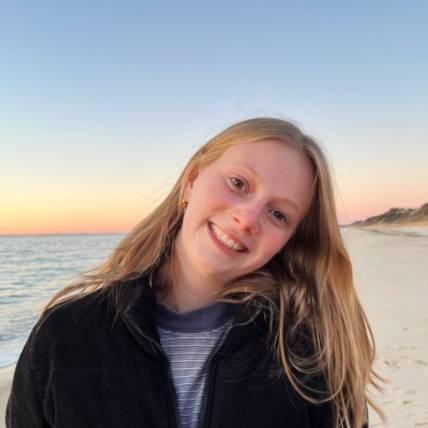
Lia Clark (MUP 2026), Co-Chair of Wagner Climate Action (WCA)
Lia Clark is a second-year MUP student focusing on the intersections of housing policy, public health, and environmental justice. Her commitment to the built environment began in her hometown in Vermont, where she served as a Student Planning Commissioner and later as an Assistant Planner for the Town of Rockingham. Before joining the Wagner community, Lia earned her degree in Environmental Studies and Political Science from Tufts University and gained experience in social service and program coordination through her work with Big Brothers Big Sisters of Eastern Massachusetts, where she supported youth mentorship networks.
At Wagner, Lia bridges her interests in urban planning and environmental sustainability through her leadership in the student community. She serves as the Co-Chair of Wagner Climate Action (WCA), a student group advocating for climate-conscious practices in urban planning, health, and public policy. As the Events Chair of the Urban Planning Student Association (UPSA), she creates spaces for students to engage with the transportation, housing, and land-use issues that shape our cities. Lia also works as a Graduate Project Assistant and a Course Assistant at NYU Wagner. Having recently interned at Unlock NYC, where she used data to combat housing discrimination, Lia is dedicated to advancing planning solutions that are as resilient as they are equitable.
Your commitment to urban planning started early, serving as a Student Planning Commissioner in your hometown in Vermont before coming to NYU Wagner. How has seeing planning through both a rural and a dense urban lens shaped your approach to building resilient communities?
Studying urban planning in NYC has been an interesting experience for me. I ultimately would like to be back in Vermont, and have spent a lot of time grappling with how I can apply the lessons of planning I am getting at the Wagner program, which is so focused on NYC, to the small community that I grew up in. Interestingly, one of Vermont's most challenging problems right now is a housing affordability crisis, similar to NYC. While the resources available and needed to address the issue are very different, a lot of the basic planning tools are the same. In both spaces, urban or rural, planning has to start with people.
You’ve shared that you’re interested in the intersection of housing policy and public health. As a Co-Chair of WCA, how do you see climate resilience fitting into that equation, and what motivated you to lead the group this year?
Climate resilience is an essential component of any equation. We can't think about housing, affordability, or public health without acknowledging the growing risks and threats of climate change. We need to be mindful of how we can both reduce our carbon footprint as well as mitigate the impacts of climate change when we are building resilient communities. My capstone project that I have been a part of this year is right at the intersection of these interests. Working with the Waterfront Alliance, my team developed a cost-benefit model to assess the impact of retrofitting basement apartments in NYC for flood resiliency in order to protect the wellbeing and safety of residents in these units that are prone to flooding. I'm looking forward to presenting our findings at the capstone expo this Spring!
You’re also the Events Chair of UPSA. How has your climate lens informed programming for UPSA this year, and what initiatives are you particularly proud of?
At UPSA and WCA we have thought of fun events that can get Wagner students outside. This Fall UPSA led a group of students on a walk from Inwood Park down to Battery Park. This all-day event traveling the length of Manhattan was a fun way for new Wagner students to get to know the city and each other. I loved that this event required no resources, just ourselves, but we were able to have an exciting and transformative experience interacting with new neighborhoods. There are a lot of activities that we can take advantage of in this city if we encourage ourselves to get outside and appreciate our surroundings as they are. As urban planners we should regularly be doing this!
Last summer, you interned at Unlock NYC, a data and advocacy nonprofit. How did that experience of using data to fight housing discrimination inform the way you think about environmental justice and community-led planning?
My experience at Unlock NYC was incredibly eye opening and I am forever grateful to have connected with this community. The research project I worked on was entirely driven, designed, and led by impacted New Yorkers devoted to improving the experiences of their neighbors when interacting with HRA, landlords, and brokers. Similarly, community-led research and planning approaches are essential for addressing issues of environmental justice and working to revitalize communities. In a class that I am taking this semester, Public-Private-Partnerships, Public Space, Politics, & the Press, we have been talking about examples around NYC where this approach has been successful.
In honor of Earth Day, what is one must-see NYC infrastructure project or green space that you think everyone should visit to see urban resilience in action?
Any local community garden! I am a particular fan of the Maple Street Community Garden in Prospect Lefferts Garden. These gardens are a fun escape and an important source of sustainable community space in dense urban areas. They are also a great way to meet other like minded individuals, access free composting, and connect with community support networks.