

Student Spotlight: Janani Venkataramanan (MPA-PNP 2026)
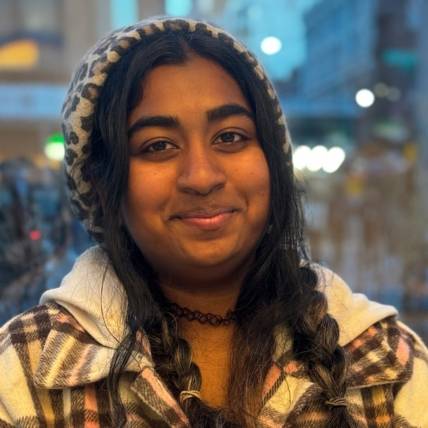
Janani Venkataramanan (MPA-PNP 2026), Co-Chair of Wagner Climate Action (WCA)
Janani Venkataramanan is a second-year MPA student specializing in Public Policy Analysis, where she bridges the gap between food policy, animal welfare, and climate action. A trained chef and graduate of the Culinary Institute of America, Janani spent years in New York City’s high-volume kitchens before pivoting to policy. Her professional journey includes serving as a Community Organizer for The Humane League, a Policy Intern for FoodStream Network, and a Chef for Wellness in the Schools, where she trained public school kitchen staff and testified at City Council hearings against school food budget cuts.
At Wagner, Janani is a central figure in the sustainability movement. She serves as the Co-Chair of Wagner Climate Action (WCA), a student group advocating for climate-conscious practices in public service through policy workshops, career networking, and campus-wide sustainability initiatives. She is also an executive board member of the Wagner Food Policy Alliance (WFPA), which provides a platform for students to engage with food systems and their environmental impact through events, advocacy, and community partnerships.
Additionally, Janani serves the broader student body as the Wagner Student Association (WSA) Communications Officer and as a writing tutor at the Wagner Writing Center. As a Sustainability Leadership Fellow with the NYU Office of Sustainability, she collaborates on university-wide initiatives to reduce waste and promote climate literacy, leveraging data-driven policy and storytelling to build a more resilient and compassionate food future.
You have a fascinating background as a chef focused on plant-based cuisine, and you’ve worked in NYC public schools through the Wellness in the Schools program. How have your experiences in the kitchen and as a community organizer influenced the way you approach climate and food policy at Wagner?
As a plant-based chef and an organizer for animal welfare, I have understood the urgency of phasing out factory farming for a myriad of reasons: animal rights, labor rights, the environment, and public health. It was this that piqued my interest in food and policy. However, it has also opened my eyes to other systemic and interlocking issues that must be addressed, like poverty, racial inequalities, and food insecurity. While working at NYC public schools, I also learned that we do not have sufficient food education for our youth.
I see food policy as a pre-requisite of climate policy, and like many of my classmates, I approach them through a social justice lens. I find it important to center frontline communities in conversations about food and climate policy. I also find it important to view animals, farmed and wild, as stakeholders in these conversations. Ultimately, I am really grateful to my professors and peers for giving me space in classes and student groups to share my perspectives on food, climate, and animals. I hope I have sparked a conversation that will continue to grow and evolve.
In addition to co-chairing WCA, you’re also on the WFPA e-board. How do you see food systems and climate resilience overlapping, and what initiatives are you most proud of having accomplished with your fellow board members this year?
Food systems account for a third of global emissions. Food waste alone generates more greenhouse gases than India, the third largest emitting country. Yet climate advocacy has largely focused on fossil fuels, with food systems only recently entering mainstream discourse. This is why, when I came to Wagner, I made it a priority to elevate food as a policy topic. Serving on the boards of WCA and WFPA was instrumental in that effort, and I'm grateful to work alongside such supportive, aligned people.
One accomplishment I'm especially proud of is bringing composting to WCA events. It started at an event we hosted called Greener Plates, Greener Futures. I brought the plant-based food, and my friend Jenny Jamison worked with facilities to arrange for a compost bin. That spark caught on, and now the IPPA conference on April 2nd will feature both composting and plant-based food.
You are known among students as a go-to resource for composting, green vendors, and upcycling. For those who want to be more climate-mindful (and animal-rights conscious) but don't know where to start, what are three simple hacks or local resources you’d recommend?
I think it is completely normal to be overwhelmed by making sustainable choices because it is not the status quo. Luckily, we live in the city, where we avoid a sizable portion of emissions by using our robust public transport system.
The easiest way for individuals to reduce their climate impact is to modify their diet. As the Wagner resident vegan, I recognize that eating plant-based, though not always, can often be expensive. I call this the sustainability tax. However, here are some local businesses that make eating plant-based affordable and delicious: 1) Bodhi Kosher Vegetarian Restaurant. It is a dim sum spot but has a $9 lunch special on weekdays. 2) Chloe in the West Village. 3) Artistic Pizza.
Apart from these spots that have explicitly plant-based items, there are Mediterranean, Chinese, and Thai restaurants that have naturally plant-based food like falafel sandwiches, tofu curries, and so on. Additionally, more and more coffee shops are dropping their surcharge on plant-based milks, making it more affordable for us to make the more sustainable and ethical choice.
Outside of food, my favorite sustainability hack is to mend clothes and use them for as long as possible. If you want to learn how to mend your clothes, and reduce the demand for fast fashion, keep your eye out for WCA’s semesterly Mend and Swap event!
Between your roles as WSA Communications Officer and a Writing Center Tutor, communication is clearly a central theme of your time at Wagner. How do you see storytelling intersecting with your advocacy for climate and food justice?
Storytelling is one of my absolute favorite tools for advocacy. Stories have been the vehicle to pass on knowledge and morals in so many cultures, and I am glad to keep it alive. Climate change can feel abstract, but storytelling brings it closer to home, helping people connect the water shortages, heat waves, and extreme weather they're already living through to the larger crisis unfolding around us.
I also think storytelling is an important strategy for movement building, something the climate movement needs. As an activist, I have found that talking to people about campaign wins or an activist’s journey can motivate more people to take action. I saw firsthand, when working to make public school food healthier and more sustainable, that sharing my personal motivation opened doors and helped me connect with kitchen staff. It inspired them to embrace the new program and create impact in their communities.
In honor of Earth Day, what is one NYU Office of Sustainability resource that is perhaps lesser known but that you’d like fellow Wagnerds to be aware of?
One Office of Sustainability resource that I feel is lesser known is the Green Events Grant. Since Wagner moved to 105 East 17th Street, we have built such a flourishing culture of events and community. With WSA having limited funding for student groups, and our groups being so ambitious with their ideas, grants like the Green Events Grant and the Changemaker Grant (bonus tip!) are ways to fund high impact events. In addition to funding, the grant from the Office of Sustainability gives climate friendly guidelines for events, which Wagnerds can learn from and implement as the norm down the line.